

TLDR
We tested whether adding sound design to boardgames is worth the hassle by asking 12 participants to play the same game with different audio setups: no sound, partial sound, and a full soundscape. We found that sound does enhance the experience, but you need to be strategic about it: voice-acted narrative and ambience work great, while isolated sound effects without supporting audio feel disjointed and distracting. Modern solutions like QR-codes make implementation easier than ever, showing them to be a valuable design tool for narrative-focused games.
Sound and Boardgames
When you think about buying a new boardgame, do you consider how well its sound design is implemented? We would guess probably not.
It makes total sense. After all, most boardgames do not feature sound design at all. Beyond, maybe the soundtrack of ruined friendships in Monopoly. Or so we thought, at the beginning of our last research project. As it turns out, when you look at the history of boardgames, you’ll find quite a few attempts at this sort of design element.
One of the older examples out there is the game Nightmare (also called Atmosfear in some markets) from 1991, that used a VHS tape to play timed storybits. Likewise, the game King Arthur from 2003 enabled sound through a battery-powered device that came with the box. But there are also more recent games, like Mansions of Madness (2016) and its app-driven soundscapes, or Chronicles of Crime (2018), which adds QR-codes to the mix, to play the right sound at the right time.
Adding sound effects in all of these different ways is certainly more complicated than doing the same in video games. Especially for your players, who need to make your system work on their end. Most boardgames don’t come equipped with some kind of speakers and for those that do, it’s more of a central gimmick that exists to elevate the experience. Most players carry a phone in their pocket, but relying on good sound quality is always a gamble.
With all that hassle, we asked ourselves the question: Is it really worth it for boardgames? The value of sound design in video games is undisputed, but do the benefits in this case outweigh the potential problems?
12 Interviews over 3 Settings
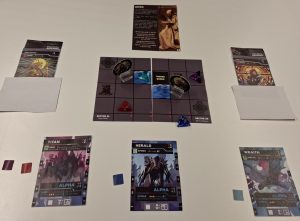
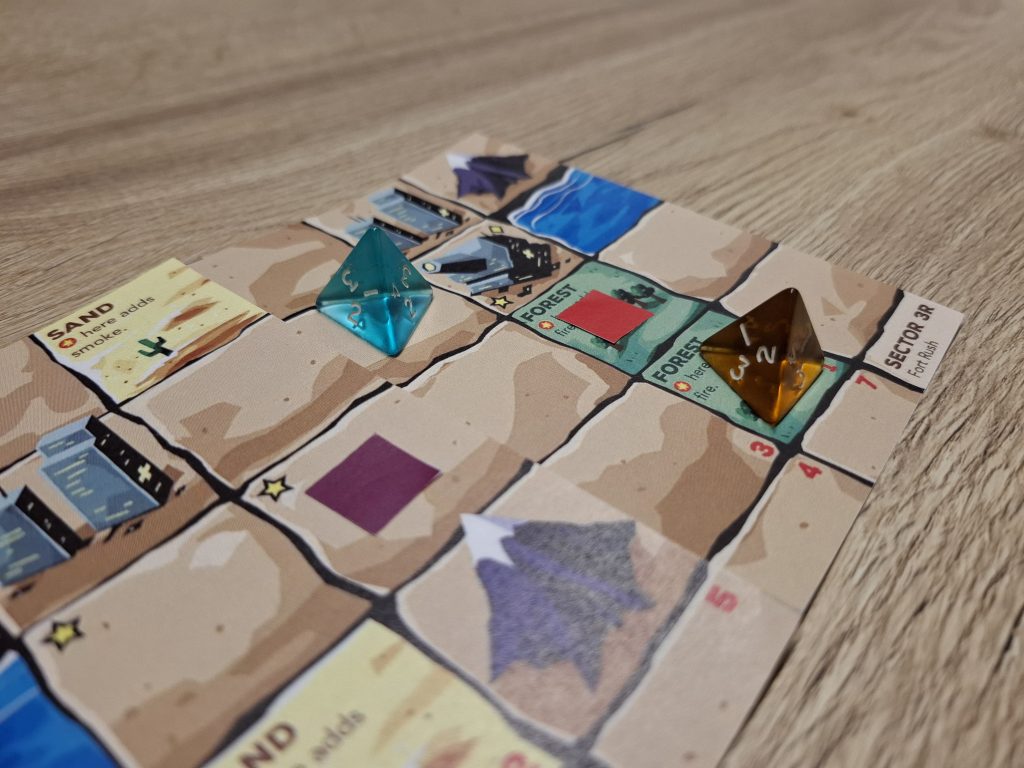
To answer this question, we conducted a series of 12 interviews, where we had participants play a modified version of the single-player boardgame Bury Me in the Rift by Matthew Bishop (2019), itself an adaptation of the popular video game Into the Breach (2018). Our modifications mostly consisted of simplifying the mechanics for short test-sessions, changing the setting and adding a proper narrative component.
In our study 4 participants played with no sound at all (except for live narration from us) and 4 with a full soundscape (except for music) that we played live on a sound system. Another 4 then played an in-between version with the narration coming from loudspeakers, as well as sound effects for only some events, like grunts for the in-game units performing an attack, or getting hit. All 12 participants played one full round of gameplay, which took about half an hour, depending on how fast they were at making their decisions.
Some Quotes
The first interesting thing that we saw in most of the interviews was that the addition of sound design in general was a pleasant surprise for most of our participants. For example, participant 8 said: “With the sound, I kind of immediately pictured, like, stone arches and a little bit of rubble here and there… It really kind of put it together for me.” Only a single participant indicated a complete preference for the original no-sound version, explaining: “I liked it more without the sound effects. It was more calm, felt more like it was a nicer atmosphere.” However, while the general impression was positive, this also depended on the cohort and the aspect of sound we asked about.
The recorded narrative parts for one were almost universally seen as a worthwhile addition. Across all participants this increased perceived immersion in the setting and enjoyment of the experience. As Participant 4 explained: “having the monks have a voice, have a vocal presence and speaking, I think gave them some amount of like, actual humanity.“ When asked, all participants in the sound versions mentioned preferring recorded narrative texts over a live counterpart.
This generally positive attitude towards our sound design changed somewhat when it came to the individual sound effects we played, especially in the cohort that didn’t get the full auditory experience. These participants only received the recorded narrative, as well as some sound effects for hero interactions, for example when striking at an enemy, or getting hit. Importantly, there was no ambience tying everything together. Participants perceived these sounds as disjointed and sometimes even startling. As Participant 4 put it: “they felt quite… distracting isn’t the right word, but disparate and disconnected from the actual physical gameplay.“ However, participants still maintained their positive impression of the voiced narrative, and noted these problems were “mainly due to the lack of other sound during the gameplay, such as additional sound effects or ambient sounds.“ When asked what sound effects could be added to further elevate the experience, most participants mentioned the current lack of background music as something that should be addressed.
These results indicate that a layered approach would be a worthwhile solution with a use case for narrative boardgames especially. This should work the best in genres like horror, fantasy, or sci-fi where atmosphere matters. While participants did react positively to the full sound effects version, implementing every sword swing and footstep in a physical game proved challenging even in our controlled research environment. The upside is that implementing every single sound effect and getting the timing right also seems to be the least important aspect out of everything we looked at. Narrative voice acting, immersive ambience, as well as engaging background music do not necessarily need to react in real time to game events, whereas live sound effects do. We would therefore recommend focusing on the former.
The Takeaway
What we learned from our study is that sound in boardgames is absolutely worth implementing, but there is a need to be strategic. Think of it as building in layers: start with solid ambience and background music that set your game’s atmosphere, add voice-acted narrative beats at key story moments, and only consider comprehensive sound effects if you can solve the timing issue convincingly. Half-measures, as we discovered, can actually detract from the experience.
The good news? Modern technology makes this easier than ever. As we mentioned at the beginning, there are already some boardgames out there that use apps, or even just QR-codes to make their sound design work. Gone are the days where you’d have to rely on VHS-technology, or even battery powered speakers to make your soundscape work. And here’s the thing: players don’t expect sound in boardgames, which means even a modest implementation can feel like a really nice surprise.
About the Authors
Sterre Fleuren is a graduate student at Breda University of Applied Sciences. Her passion lies in sound design for film and television, and now games, where she is currently looking for new opportunities.
To get in touch, visit: https://www.linkedin.com/in/sterre-fleuren-034653280/
Jonas Pastoors is a researcher at Breda University of Applied Sciences, where he is currently working on his Professional Doctorate about parasocial relationships with NPCs in system-driven games.
To get in touch, visit: https://www.linkedin.com/in/jonas-pastoors