

Interview Credits: Georgina Cammalleri, Pat Pineda and Zdravko Stoitchkov
Image and Video Credits: Right to Fight (Cammalleri, 2023)
“Why don’t we just greenscreen it?” said a fellow colleague to Georgina Cammalleri, director of the featuredocumentary ‘Right to Fight’, causing her to have nightmare visions of her documentary participants’ hair“being covered in green snotty pixels and looking like a floating head.” “The idea of it really freaked me out”she said. The film, which tells the story of pioneers in women’s boxing, was shot across the U.S., including the states Louisiana, California, Oregon and others, but in post-production, there were gaps in the masterinterviews filmed on location, or certain parts needed to be refilmed. The problem? The budget remaining after filming the master interviews on location was small, and returning to those original locations was not an option.
Although it was not an option, it still needed to be filmed, preferably without having to use a green screen.That’s when Georgina remembered a taster session she had attended with the company Final Pixel, which introduced her to LED volumes—large screens that act as a virtual background for cameras, creating realistic environments inside a studio. The idea: What if they flew all of the participants to New York and recreated the original locations using this technology?
It was a bold idea, that fit the budget. The plan was to use an LED volume to mimic the various interview locations, such as a diner, a boxing ring, and an office. But to make it believable, every detail had to match the original shots: the lighting, the camera angles, the set design and especially the background. For the background, they needed clean plates—footage of the original location for the LED volume to act as a backdrop for the interviews. Clean plates can be created by filming 5-10 seconds at the start and end of the interview on location, with no one in the frame. Unfortunately, most of the existing footage had someone in frame for the entire time, as the director, Georgina, had not anticipated using LED volumes. There were “moments where the women would go down to pick up a bottle of water or they’d go to the toilet, and suddenly you’ve got the clean plate” said Georgina. But, in some interviews, these moments did not occur, meaning there were no clean plates for these locations. To solve this, VFX supervisor Zdravko Stoitchkov was introduced in the filming process. His task was to stitch together several sections of different parts of the footage to make a clean plate. This was successful.
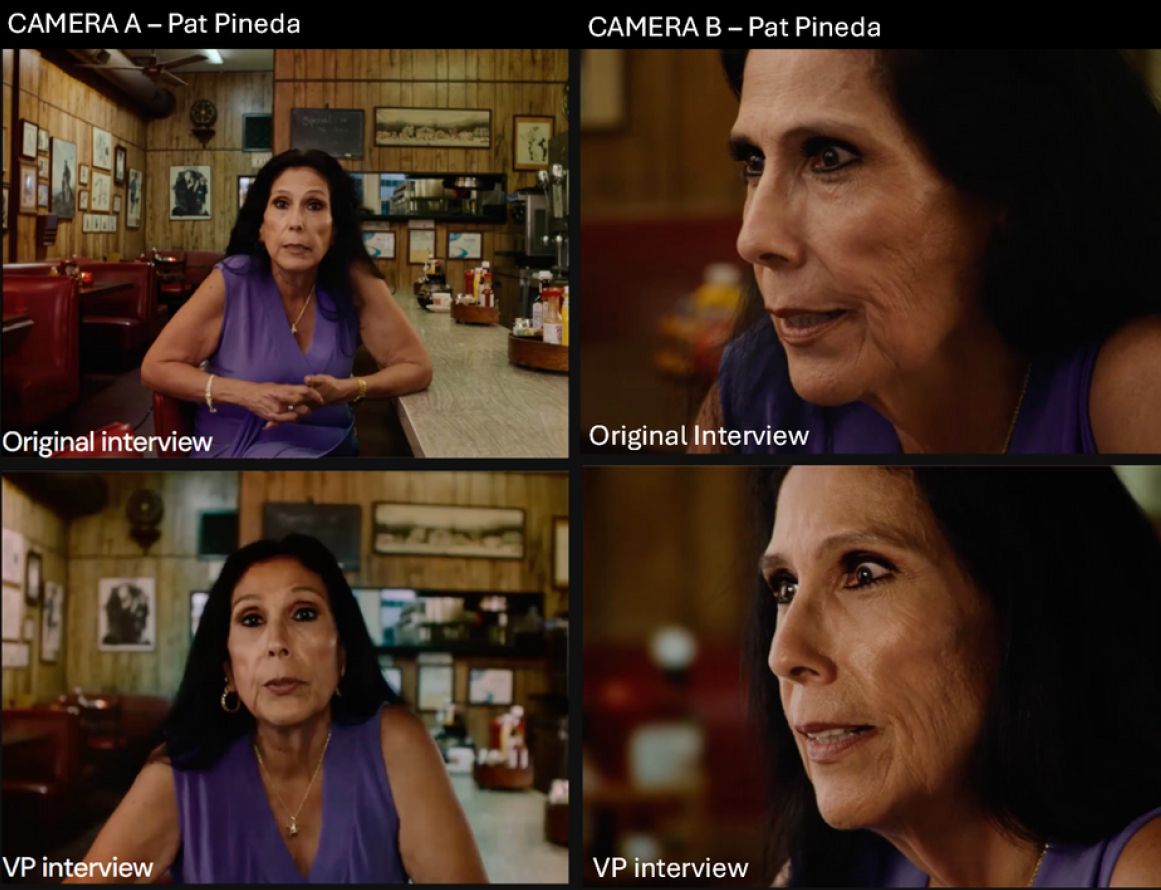
The backgrounds were now created, production moved to Final Pixel’s LED volume studio in New York, but the challenges did not end there. During the master interview with Pat Pineda, the first licensed female professional boxer in California, she was positioned with her arm resting on a bar and sitting on a stool. In the LED volume, Georgina did not have the art department to rebuild this bar or the specific stool used. Part of the problem was solved by changing the lens. The cinematographer switched to a 50mm lens, cropping out the bar and the stool with a tighter framing. But, if Pat sat in a different stool or did not have her arm resting on a bar, her posture would change, something that is noticeable on camera. To fix this, the team attached a shelf to a C Stand to act as the bar and found a stool that was very similar to the original. Even at this stage though, the problems kept arising; the footage used as the plate was too bright, and as the background is an LED volume, which is a light source, it resulted in too much rim light on Pat’s hair. The solution was, fortunately, simple: darken the image using the software Assimilate’s grading capabilities.
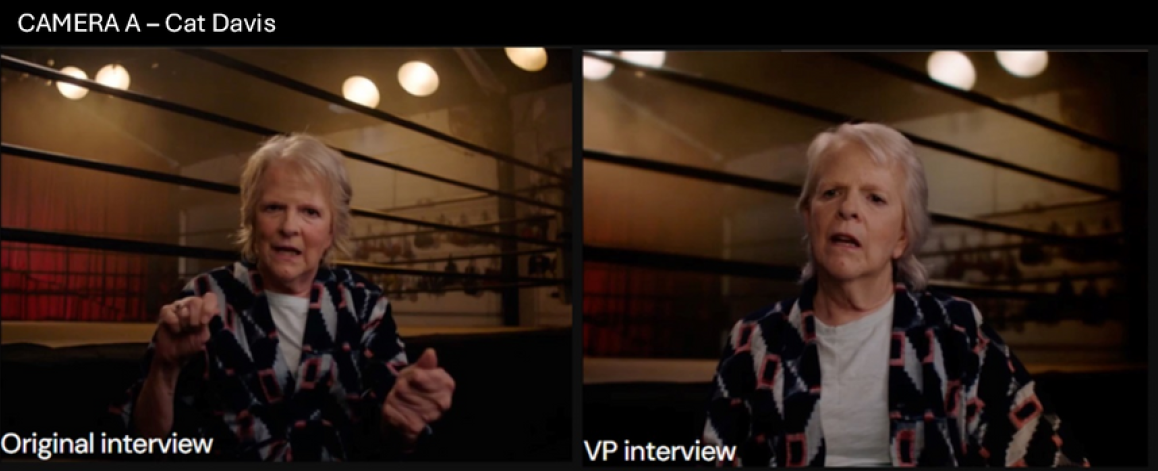
Next up was Cat Davis, the joint first licensed female professional boxer in New York. Georgina, and her team faced another potential challenge. The original footage had moving haze behind Cat. If they did not have any clean footage to use as a video background, it would be less than ideal; a pieced-together photo plate would have static haze. “We got lucky,” Georgina said, Cat left the frame to use the toilet during filming, and the camera kept rolling. This meant the team had 20 seconds of footage that they could loop as a video plate for the background. The moving haze on the LED volume really helped sell the illusion.
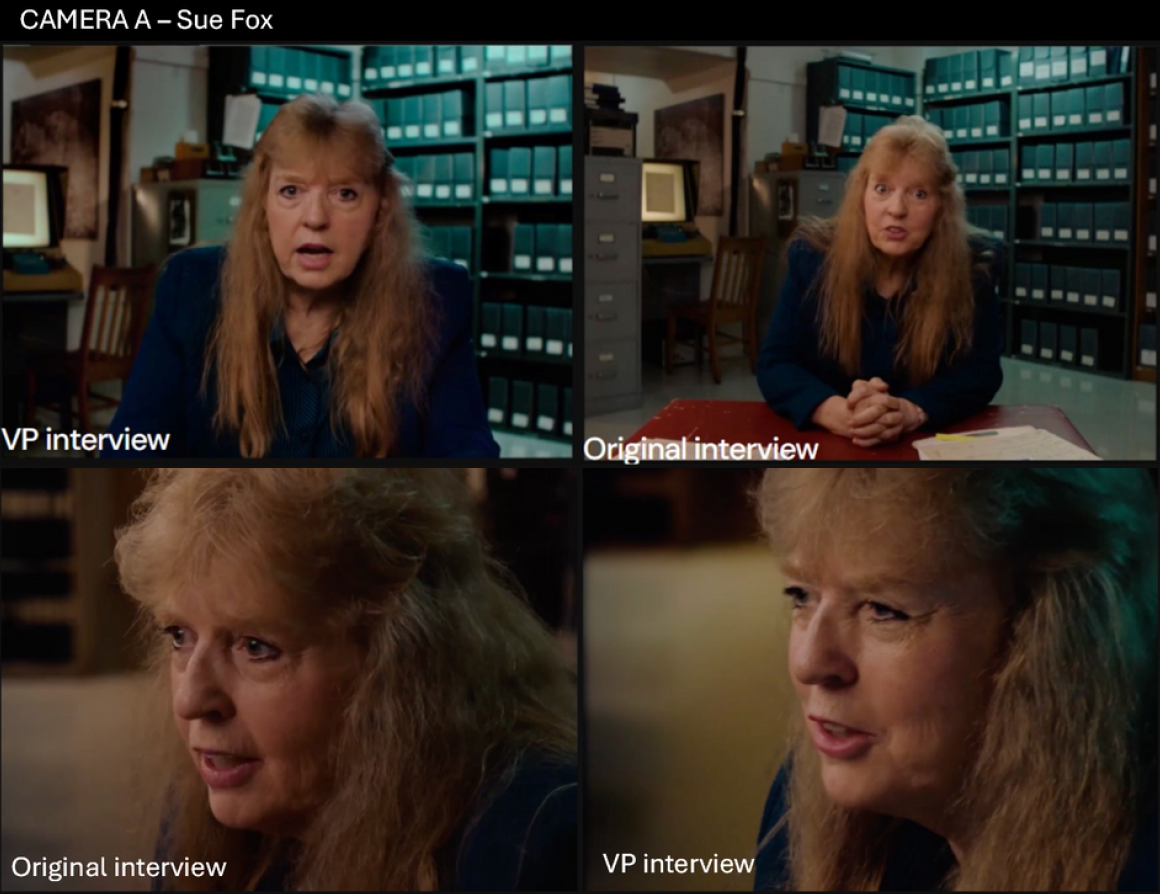
The pick-up interview with Sue Fox, a boxer and historian, was recreated using metadata to match the exact lighting, camera angle and framing, “everything as it was” on location. But something looked off; it did not match the original master interview. “We weren’t sure why…we started to panic”, said Georgina. The team decided to get some food early, because they did not know what to do. “We’re there just eating away at our sandwich looking into space, panicking, and, then the director of photography, DP realises that it was a colour issue…he runs back into the studio… he basically realised that the LED wall wasn’t emitting the same reflected teal light that the original physical walls had.” To solve this issue, the DP needed to use a teal backlight to replicate the effect of the teal file cabinets in the actual location.
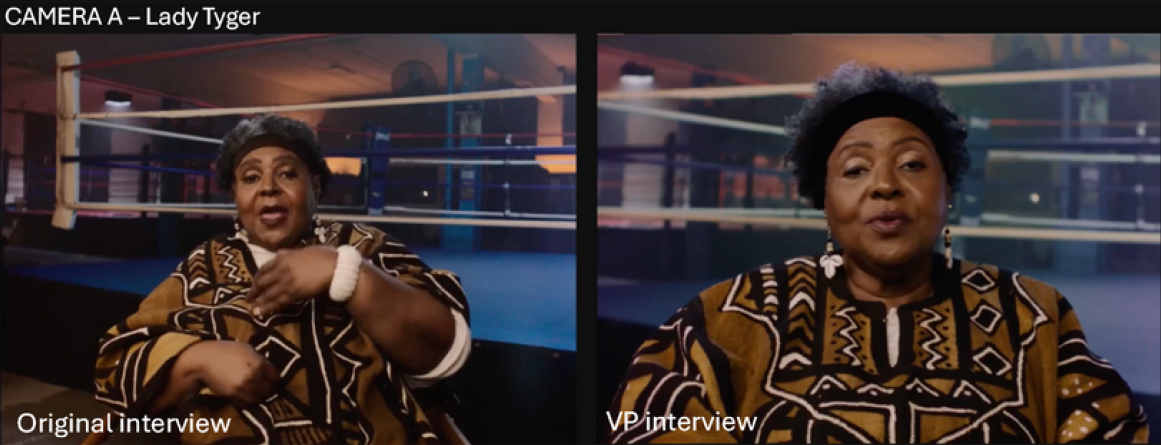
In the final edit, Georgina felt the pick-up shots were so convincing that she, herself, was unable to see which ones were done on location and which in the studio. Except for one detail that gave it away, in the interview with Lady Tyger, the joint first licensed professional boxer in New York. “One of the contributors originally had silver eyeshadow, but on the day of the pickup, we only had gold eyeshadow. I had to really squint and look at that eyeshadow and be like, okay, that’s a pickup.”
Despite the success, Georgina expressed some mixed feelings about the use of LED volumes. “These spaces, they have scripted in mind, right? They have actors in mind, people who are used to having 30 people watching them and lights and everything. A contributor is different. And so I’d be interested to know what a virtual production world would look like if you wanted to make it more intimate?” She was particularly concerned about how this impacted the trust connection she had built up with her participants and their feelings of being in front of an LED volume with more people watching and multiple pieces of technical
equipment. “The LED is built for the shots you need rather than for the contributor to see where they are.”
But her concerns were challenged by the documentary participant Pat Pineda, who preferred the LED volume to the actual location. This was a shock to Georgina. On location, there were continuous retakes of the master interviews due to interruptions from the air conditioning, which would periodically turn on and off, as well as outside traffic noise. Not only that, but due to the extreme heat on the day of filming, the crew had to keep reapplying makeup to the participant because of sweating. Pat found it very uncomfortable. In the LED volume, everything was controlled. “It’s nice and cool, and you’re not sweating bullets, and you don’t have to worry about sound.” Pat could even see a noticeable difference between the two interview locations in the film. The takes made in the LED volume studio were more authentic to her. She said her storytelling approach is, “off the cuff. So to keep having to do things over again … you just lose things in it. So when I see that, I thought, god you sound boring, Pat (laughs).” The LED volume was better for her.
Georgina and her team faced both struggles and triumphs in the process of using VP, but Georgina remains keen to continue using it as a tool for documentary filmmaking. If you’re eager to use LED volumes in your documentary production, I’ve created a comprehensive guide. The guide was made through interviews with Georgina, Zdravko, Pat, other filmmakers and LED volume studio professionals. It includes working with participants, maintaining their well-being and that of the crew, obtaining informed consent, and practical tips to keep in mind in VP, among other things.
Take a look: LED Volumes for Documentaries Resources